What you are actually buying
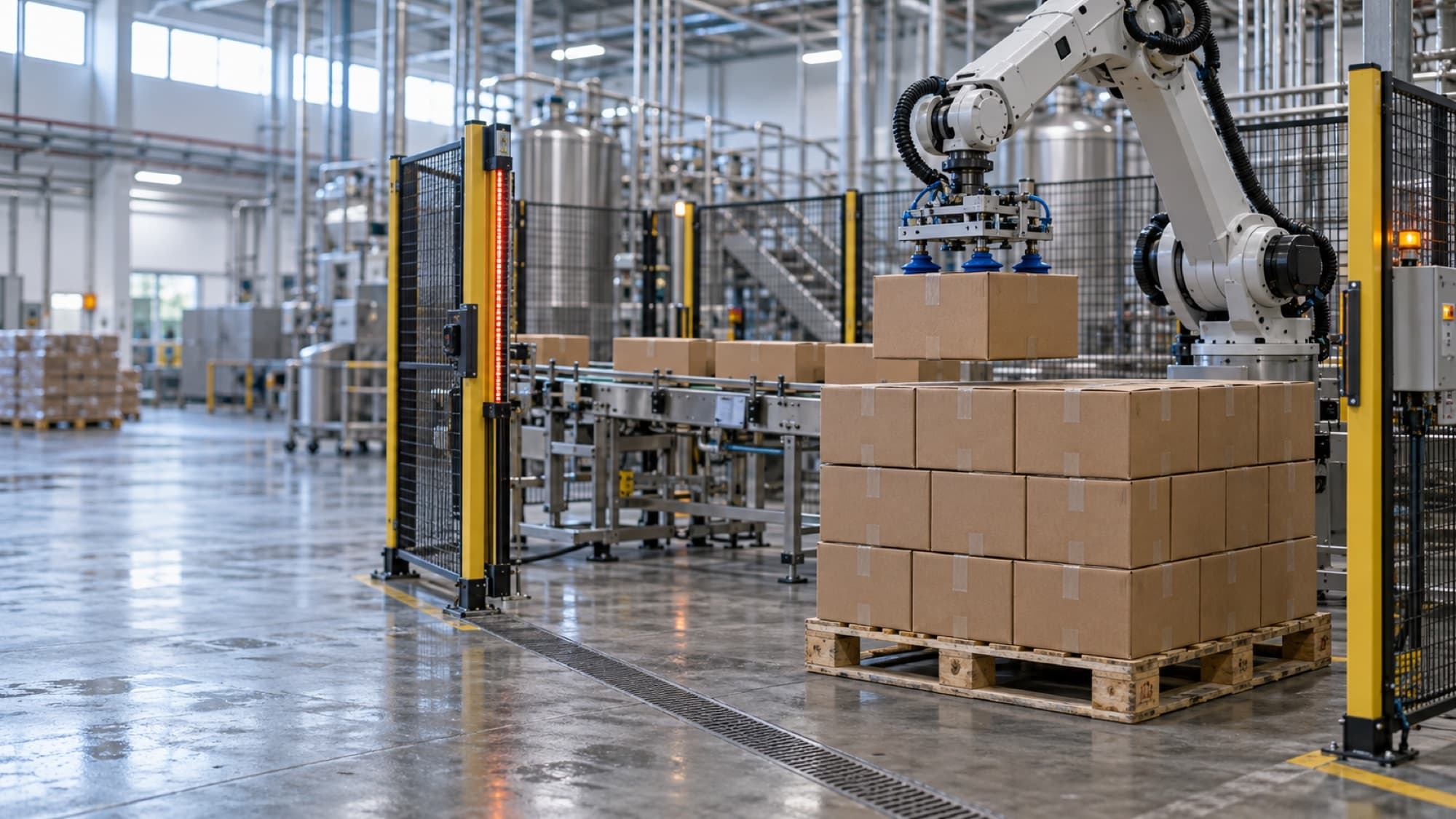
A palletizing cell is not a robot. It is a robot, an end-of-arm tool sized to your case, a pallet dispenser, an infeed conveyor running at case height, a pallet conveyor or shuttle on the discharge, a safety perimeter with an interlocked gate, and the controls that tie all of it to the line upstream. The robot is usually the least interesting part of the quote and the least likely thing to go wrong. The tooling and the pattern software are where projects succeed or stall.
Pin the rate first
Every other decision follows from cases per minute. Below roughly 8 cpm a collaborative robot on a lift column is often enough, and the cell fits in a footprint that does not need fencing. Between 8 and 25 cpm you are looking at a conventional six-axis arm with a vacuum or clamp tool. Above 25 cpm you are into high-speed gantry or layer-forming territory, and the conversation shifts from robot selection to infeed metering and pattern buffering.
Bring three numbers to the first call: peak cases per minute, the number of distinct SKUs the cell must handle, and the case dimensions and weight at both extremes of that range. An integrator who quotes without asking for all three is quoting a robot, not a cell.
What good looks like
A factory acceptance test before anything ships, run at your actual rate with your actual cases, not a demo at half speed with a sample box. Pattern software you can edit yourself when a new SKU arrives, rather than a service call every time marketing changes a carton. Documented changeover time between SKUs, in minutes, measured rather than estimated. The PLC code delivered to you, commented, with the program in a format your maintenance team already runs.
Ask what happens when a case arrives skewed on the infeed. A good answer involves a metering device and a vision check. A bad answer is that it will not happen.
Questions to ask every candidate
- How many palletizing cells have you commissioned at or above my rate, and can I call two of those plants?
- Do you design and build your own end-of-arm tooling, or subcontract it?
- Who writes the PLC code, and do I own it at the end of the project?
- What is the measured changeover time between my two most different SKUs?
- What does your FAT include, and will you run it at full rate with my cases?
- What spare parts do you recommend I hold, and what is your lead time on them?
- What happens at 2am on a Sunday when the cell faults and nobody on site can clear it?
Robot brands you will see quoted
FANUC dominates palletizing in North American food and beverage, largely on the strength of the M-410 and M-710 families and a dense service network. ABB and Yaskawa Motoman both hold significant share, and Kawasaki appears often in heavier bag-handling work. Universal Robots and other collaborative arms show up almost exclusively at the low-rate end where fencing can be avoided.
Brand experience on an integrator's profile tells you about their programming environment and spare-parts relationships. It is not a quality signal on its own, and a firm that works in one brand exclusively is not automatically worse than one that works in four.